Lesson 2,1 · Communication · Focus — Flow or Stress?

Where do you stand today?

Every task you carry sits somewhere between what is asked of you and what you can do. Learn to point to exactly where — in plain, blue head-language your manager will recognise at your next appraisal talk.

Flow Code
Read your own position on the challenge/skill axis before you sit down across the table.

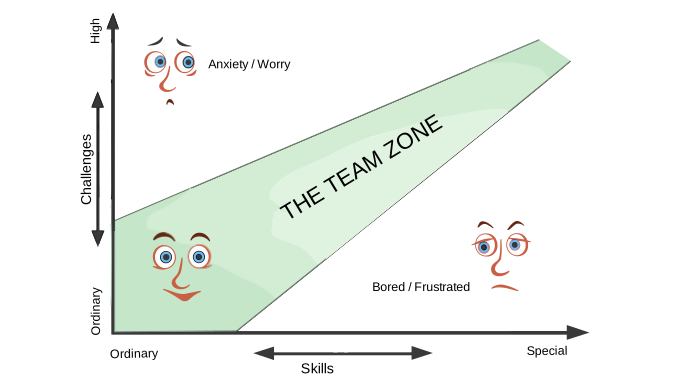
The team zone — challenges on the vertical axis, skills on the horizontal, with the flow zone as a green band between anxiety above and boredom below
The flow chart — the blue symbol of Secret 2.

Lesson video · 2,1

Go deeper with Lesson 2,1

Take this lesson further in the SGL Coach app, with video and your own coach.

Unlock in SGL Coach (opens in a new window)

Opens the SGL Coach app in a new window.

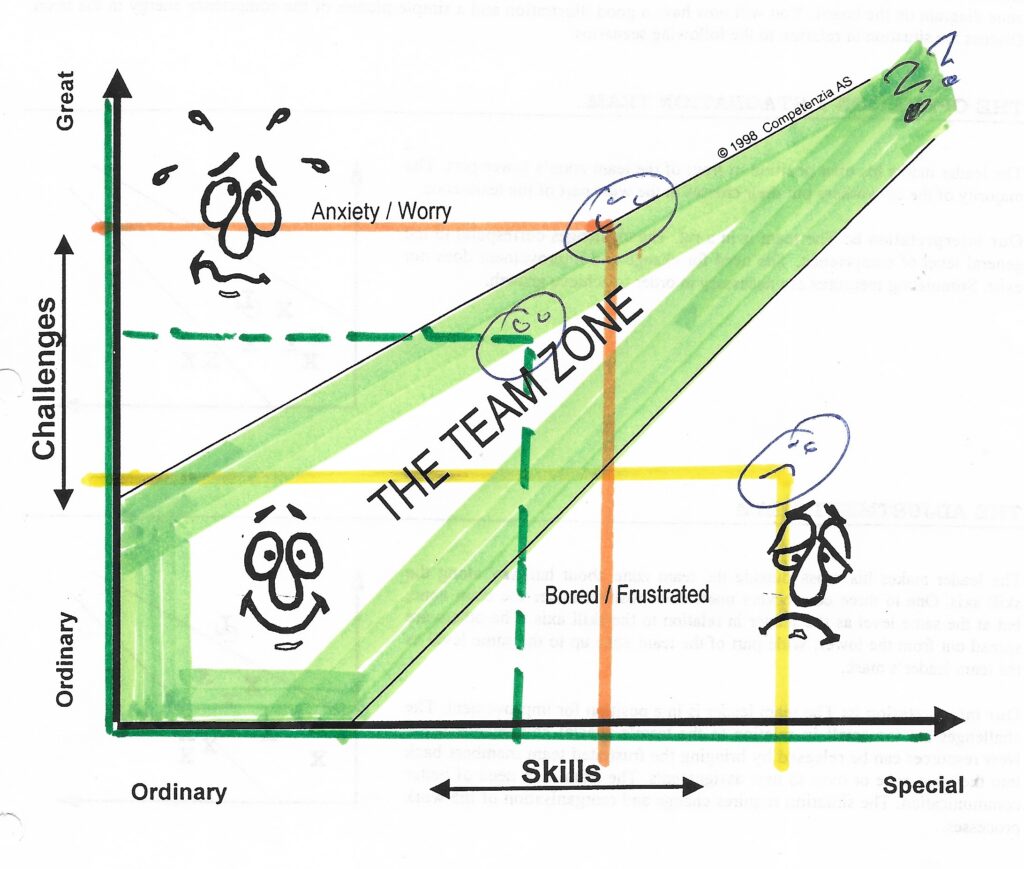
The original 1998 team zone drawing — hand-coloured, with three marked positions: one inside the flow zone, one above it in worry, one below it in frustration
Two axes, three positions — the same chart Secret 2 opens with.

Three positions on the chart

Plot any task on two axes: how much it challenges you, and how much skill you bring to it. Wherever the two lines cross tells you something an appraisal form never quite manages to. Below each position is a sentence you can actually say out loud in the room.

Too much challenge

Stress and anxiety

The task is bigger than your skill. You work harder, and get less done.

In blue language: “This quarter asked more of me than my current skills could match.”

Challenge meets skill

The flow zone

Time disappears. The work carries itself, and it gives energy back.

In blue language: “Here the task and I were matched — the work carried itself.”

Too little challenge

Boredom and apathy

Your skill is unused. Ask yourself what is stopping you from being the best you can be.

In blue language: “This task no longer uses what I can do.”

A leadership lesson

The appraisal that finally worked

A client of mine used to dread her own appraisal talks — not because the feedback was harsh, but because she never knew how to describe the year in a way that felt true. “Good,” she would say, or “busy,” and the conversation would drift.

We drew the chart together beforehand. Three columns: what drained her, what she barely noticed doing, and what had made an afternoon disappear. She walked into the meeting with three real sentences instead of one vague word, and for the first time her manager knew exactly what to give her more of.
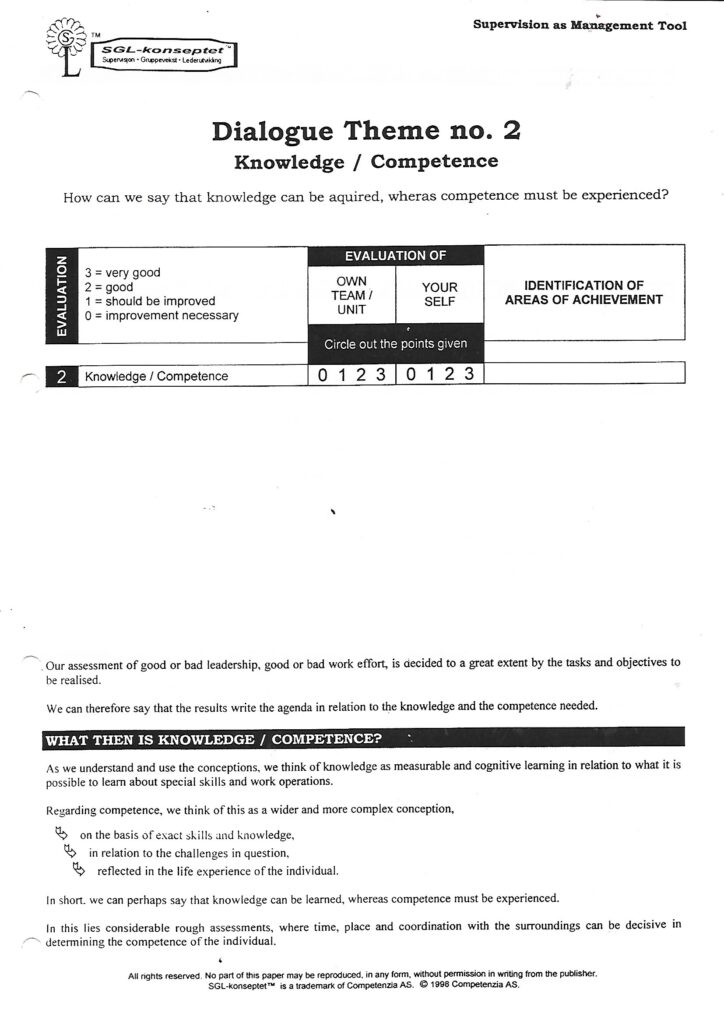
A scanned SGL worksheet from 1998, Dialogue Theme no. 2 — Knowledge / Competence, with an evaluation table to be filled in before the appraisal talk

Your turn

Home Lesson 2,1

Imagine the situation: you are invited to your annual performance review about your work situation, well-being, development and future goals.

Try to prepare yourself by using the FLOW model, and send a picture of your position in the Team Zone.

Get an assessment from the JP agent

  1. Write down your experiences with this home lesson.
  2. Click Open the JP agent. It opens in the SGL Coach app in a new window.
  3. Paste your notes into the chat with the JP agent and ask for an assessment.
Open the JP agent (opens in a new window)
All home lessons →
An open notebook and two sharpened pencils on a dark desk under the pool of light from a lamp, the page still blank
SGL Secrets — For those who are in need, and those who want a lot!

Next lesson

Lesson 2,2: Flow and Secrets

Continue to 2,2 →