
Lesson 2,3 · Communication · Focus — Flow and Teams

Take the flow zone off-site

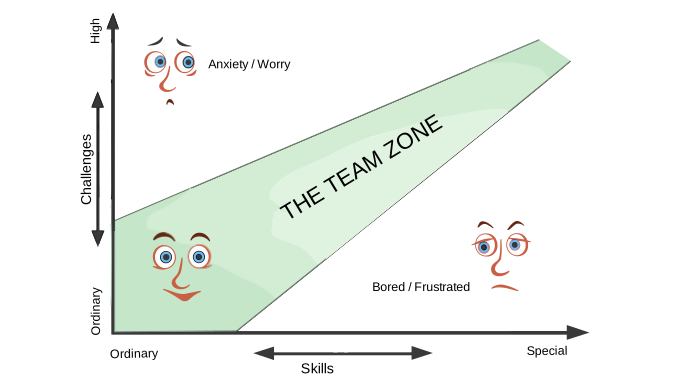
A team finds flow the same way a person does — challenge matched to skill — but it needs the room, the task, and the ritual to be set up on purpose. Good ideas for a creative workshop off-office.

Off-office
Change the room, and you change what the room lets people say.

The team zone — every member's mark, gathered on one diagram
Flow and Teams — the workshop lesson of Secret 2.

Lesson video · 2,3

Go deeper with Lesson 2,3

Take this lesson further in the SGL Coach app, with video and your own coach.

Unlock in SGL Coach (opens in a new window)

Opens the SGL Coach app in a new window.

A tight pack of runners in shorts and singlets on an open road, seen low from ahead, arms swinging and every one of them mid-stride
Same team, same challenge — a different room changes what gets said out loud.

Why leave the office

The office is full of small, correct habits: who talks first in this room, which chair belongs to whom, what tone is allowed in front of the boss. None of that is wrong, and none of it helps a team find flow together. Flow needs a fresh surface — a room nobody has a fixed role in yet.

That is the whole case for going off-office: not a reward, not a break from work, but a deliberate reset of the challenge/skill balance for the group as a whole.

Off-office workshop

Five ideas for your next session

Start with these three, and keep the last two in your back pocket for the room itself.

1 · The room

Change the room

Any room that is not the usual meeting room. A kitchen table, a walk outdoors, a borrowed office — the point is that nobody already knows how to behave in it.

2 · The task

Give everyone an edge

Pick a problem that is genuinely a little too hard for the group as it stands today. Too easy, and the room goes flat within twenty minutes.

3 · The ritual

End with a shared ritual

A closing round where everyone names one thing that gave them energy. It fixes the flow state in memory, so the team can find its way back to it later.

A leadership lesson

The whiteboard that stayed empty

A team I worked with had spent three meetings staring at the same whiteboard, unable to agree on where a new project should start. Nobody was wrong, exactly — they were simply too comfortable with each other's usual roles to challenge one another.

We moved the same conversation to a borrowed cabin for an afternoon, gave it one hard question instead of ten easy ones, and closed with everyone naming what had felt alive that day. The whiteboard back at the office was full within a week — not because the people had changed, but because the room finally let them.
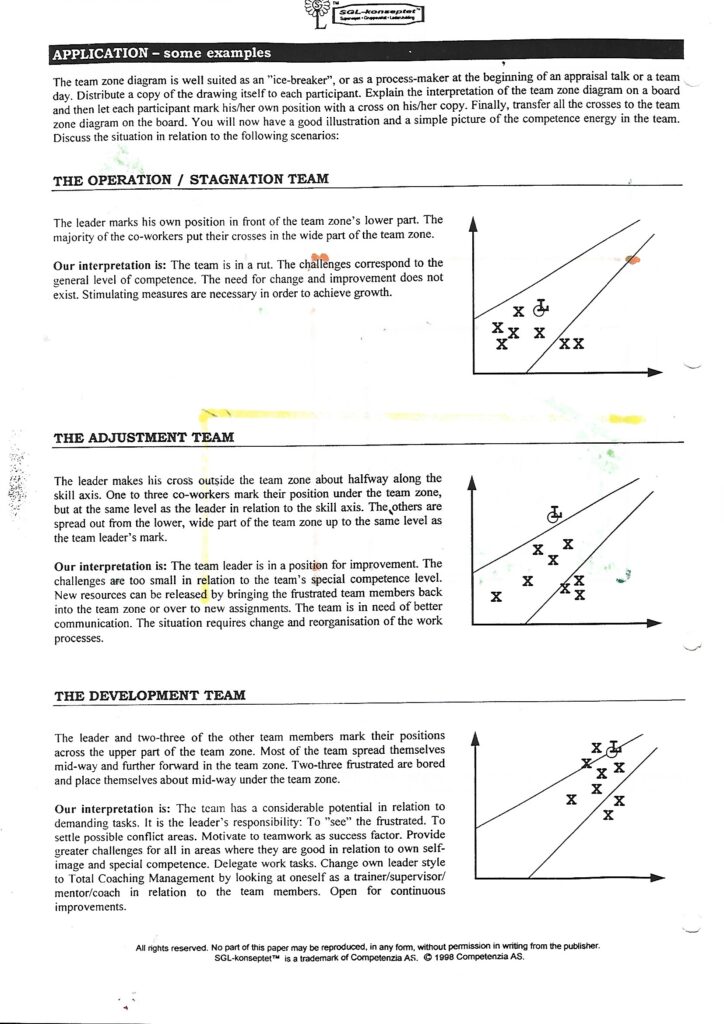
A scanned SGL worksheet from 1998 — Application, some examples: the operation/stagnation team, the adjustment team and the development team, each with a small sketch of crosses on the team zone

Your turn

Home Lesson 2,3

Take an A4 sheet of paper and write down the first names of all your group colleagues. Then place them in order in the FLOW diagram, where you feel they would place themselves. Start with yourself, and then fill in the others.

Compare the results with the examples above. What is true, and what is false?

Decide to find the truth by inviting the group to an off-office workshop. Plan it by deciding on:

  • The room you would borrow, and why it is different from your usual one.
  • The one task with a genuine edge to it.
  • The closing ritual you will end on, and who will hold the clock.

Tick each one off as you decide it. All three, and your session is ready to run.

Get an assessment from the JP agent

  1. Write down your experiences with this home lesson.
  2. Click Open the JP agent. It opens in the SGL Coach app in a new window.
  3. Paste your notes into the chat with the JP agent and ask for an assessment.
Open the JP agent (opens in a new window)
All home lessons →
An open notebook and two sharpened pencils on a dark desk under the pool of light from a lamp, the page still blank
SGL Secrets — For those who are in need, and those who want a lot!

Next secret

Secret 3: Leadership · Double-Loop Learning

Continue to Secret 3 →